From Alexandroupoli to Europe: How EPIC-X Helped a University Spin-off Think Global
Ekaterini Alexiou-Chatzaki, Founder/CEO of ABCureD
What can happen when a university spin-off from the edge of Europe is given access not only to funding, but to the right people, knowledge, networks? And a community of women who share the same passion for turning science and technology into impact?
ABCureD was born at Democritus University of Thrace in Alexandroupoli, Greece, as its first biomedical spin-off. We are developing LPancreas, a precision diagnostic based on pancreas-derived cell-free DNA methylation and artificial intelligence, designed to provide information that current diabetes diagnostics cannot: what is happening to the pancreatic beta cells themselves.
We know well by now that excellent science alone does not build a company. Translating academic research into a deep-tech venture requires a completely different set of skills: understanding markets and customers, navigating regulation, raising capital, building the right team and be able to manage it, communicating a vision to the right target and learning to make decisions with incomplete information. In Alexandroupoli, we do not have a large biotech ecosystem on our doorstep. Our researchers do not routinely encounter investors, serial entrepreneurs or biotech executives in their everyday environment. Or observe any success stories to evolve. Access to international networks therefore matter enormously.
The milestones matter but so do the people
During EPIC-X, ABCureD reached three milestones that are particularly important for our transition from university spin-off to internationally oriented biomedical company. Our European patent protecting the core technology behind LPancreas moved to grant. We clarified our regulatory pathway and aligned the next steps towards an FDA pre-submission. And we secured new private investment. But the best part: we had fun. I met an extraordinary group of clever, passionate and ambitious women with whom I discovered I had so much in common… We came from different countries, disciplines and professional backgrounds, but our tasks were surprisingly similar: trying to translate an idea into something real; balancing scientific or technical ambition with commercial reality; building teams; fundraising; coping with uncertainty; breaking bias; and more. There was great energy there. We learned from each other, challenged each other, laughed together and created relationships. For me, this is an underestimated part of entrepreneurship programmes. You need knowledge and connections, but you also need peers. Particularly for female founders, meeting other women who are equally passionate about building ambitious companies creates confidence, belonging and momentum.
Bringing the entrepreneurial experience back to Alexandroupoli
One of the programme’s greatest strengths was the dual form of learning, remote and on site. Talented researchers in our teams working in regional universities do not necessarily have regular access to international startup ecosystems or specialised business training. Through EPIC-X webinars and capacity-building activities, our team could participate in that environment directly. Researchers who naturally think first about experiments, data and publications were exposed to questions of customers, intellectual property, regulation, market access and value creation. That matters enormously for a university spin-off. If an academic innovation is going to become a company, the team around it must gradually begin to see the technology through a wider lens.
Sometimes the most valuable resource is someone who responds
EPIC-X also showed us what a functioning network really means. Here is an example: at one point, we were preparing a funding proposal and a collaborator we were relying on stopped responding while the submission deadline was rapidly approaching. Through the programme network, we were introduced to an alternative partner. They immediately understood what was needed, reacted extraordinarily quickly and helped us restructure the project within a very short timeframe to a successful application. For an early-stage company, this kind of support can be transformative: a network that responds when it matters.
The same principle applied elsewhere. Coaches connected us with internationally recognised diabetes experts, resulting in engagement from Key Opinion Leaders and Letters of Support from leading European diabetologists. We were also connected with an entrepreneur who had built a successful biotech company and made an exit to big pharma. Beyond sharing her experience, she offered to continue helping us through this network. These are connections of immense value that can shorten a startup’s learning curve by years.
ABCureD in 2050: allowing ourselves to imagine
Some of my favourite EPIC-X moments, however, were those that pushed us completely outside our normal way of thinking. During a Futures Thinking exercise in Portugal, we were asked to imagine ABCureD in 2050. Our future ABCureD industry had expanded far beyond diabetes to conquer cancer affecting women in countries adopting a population screening program. Yes, fictional. But that was exactly the point: Think Big, Think Far! Scientists are trained to stay close to the evidence. We start with what we know today and cautiously move one step forward. Futures thinking asked us to do the opposite: imagine an extraordinary outcome first and then work backwards. That’s a totally different perspective. It shifts the question from “Can we develop this test?” to “What difference could this company ultimately make?”
Learning from women who had already been through the difficult parts
Some of my most memorable encounters during EPIC-X were with remarkable female role models. What impressed me was not simply their success. It was their openness about what had happened before the success. We heard deeply personal stories of setbacks, crises and moments when carefully constructed plans collapsed, and how those same moments ultimately opened completely different paths. Entrepreneurship is often presented retrospectively as a neat sequence: idea, startup, investment, growth, success. Anyone actually building a company knows that the reality looks very different. Hearing successful women talk openly about uncertainty and failure was therefore both reassuring and empowering. They were not presenting perfect careers for us to admire from a distance. They were sharing real lives from which we can learn.
Learning by seeing how others build
My EPIC-X mobility was another highlight. It gave me the opportunity to spend time inside an ambitious European deep-tech company and discuss very practical questions: R&D strategy, decision-making, team building, dilutive versus non-dilutive funding and how a scientific organisation evolves as it grows. The visit opened concrete possibilities for collaboration. One introduction also led to another and a useful pool of experienced collaborators was built. This is what a European innovation ecosystem should do: allow knowledge, relationships and opportunities to travel across borders.
Taking entrepreneurship back to the university
In the opposite direction through our multiplier event, we exposed young researchers to entrepreneurship and to the possibility of translating science beyond academia. The event attracted significant interest from researchers curious about becoming part of a startup environment and entrepreneurship became less abstract. I find this particularly important. University spin-offs become bridges between academic research and entrepreneurship. Academics begin to think: perhaps I can do this too. This is how ecosystems are built.
Giving a Widening region a seat at the table
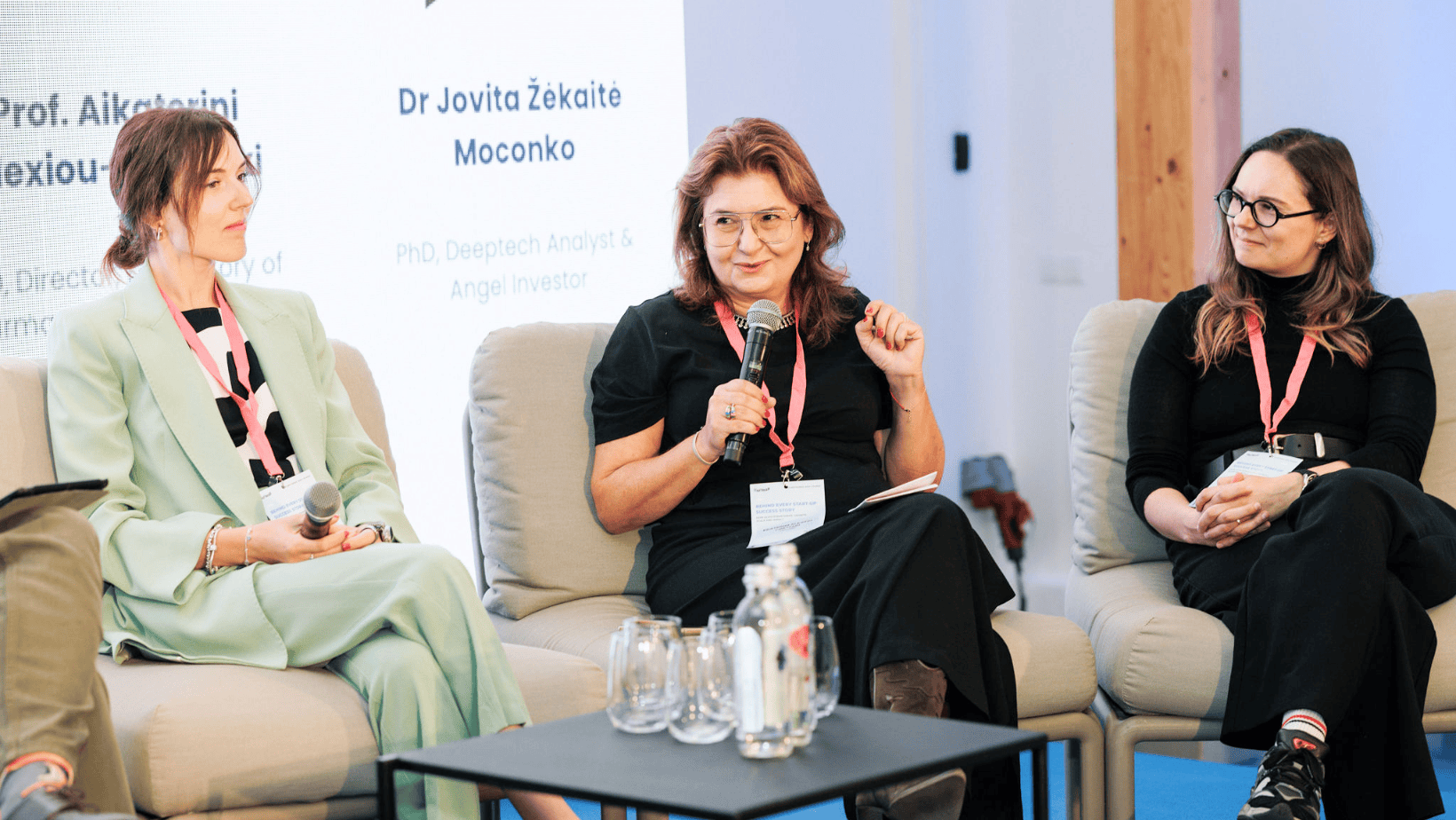
ABCureD is far from Europe’s established biotech hubs. But excellent science is not confined to established hubs and Europe cannot afford to leave promising research trapped within universities. Our clinical collaborations can be international. Our investors can be international. Our networks can be international. And our ambition certainly is not regional. This is why programmes such as EPIC-X matter particularly. Access to capital, experienced mentors, entrepreneurial know-how and networks becomes less geographically uneven. But EPIC-X eventually allowed us not only to benefit from European innovation policy, but also to contribute to it. In the demo-day in Vilnius, I had the opportunity to participate in the discussion panel “Building Stronger Start-up Ecosystems: Innovation, Investment and Growth in Europe,” bringing in our perspective. This was an opportunity to contribute shaping the conversation about what the ecosystem can become and how and have a voice in designing it.
Visibility creates opportunities
An important outcome of EPIC-X was visibility. Through the programme, demo days, international events, mobility activities, videos and public discussions gave us opportunities to tell our story to a much wider European community. I realised that this kind of visibility has effects that are difficult to measure. It creates introductions, conversations and credibility, but it can also reach people you never expected. Under the EPIC-X video, my 15 year old daughter wrote: “What a privilege to be her daughter.” What a reward! but it also made me think: if seeing women build companies, take risks and think big makes the next generation see those possibilities as normal, that is an impact worth working for.
More than acceleration
Looking back, it was the combination and the pace over the six months that mattered. A patent moving to grant; An FDA pathway becoming clearer; Private investment secured; A European funding application; International diabetologists supporting our technology; Fundraising coaching; Mobility and collaboration with another European biotech; Greater international visibility for our company, our team and the region we represent; Entrepreneurial training reaching our scientific team; Raising interest in young researchers; But also dinners, laughter, unexpected conversations, nice photos with big smiles, ambitious ideas, with fellow women from across Europe with which we share vision.
EPIC-X connected us to entrepreneurial knowledge that is difficult to find locally. And it gave me a community of passionate women with whom I could identify and grow. Beyond, EPIC-X gave me three things I had not fully expected: the confidence to think bigger, friendships, and the realization that our entrepreneurial journeys are being watched by the next generation and will eventually multiply.
This article was written in collaboration with ABcureD. For more information about their work visit ABCureD‘s website.
Find out more about the project here!