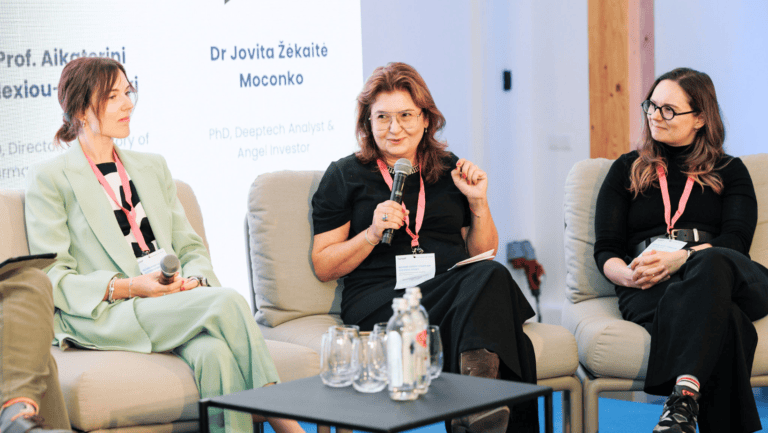
Portugal’s Deep Tech Momentum — and the Women Still Fighting to Be Heard
Portugal has become a compelling example of how innovation can provide a courageous
response to economic adversity. Over the past decade, Lisbon has developed into one of
Europe’s most visible innovation centres, attracting international entrepreneurs, investors and
companies while projecting the Portuguese ecosystem far beyond the country’s borders.
This transformation did not happen overnight. Portugal has combined strong academic
institutions, highly qualified graduates and competitive operating costs with a growing network of incubators, investors and innovation programmes.
Yet the ecosystem still faces a persistent bottleneck: excellent science and technical knowledge
do not automatically translate into entrepreneurship. Many talented graduates continue to favour
the stability of large corporations or opportunities abroad, while promising ideas struggle to
leave the laboratory and secure the investment required to reach the market.
These difficulties become even more pronounced when entrepreneurship, including deep tech,
is examined through a gender lens.
Deep tech is not a single, uniform environment. The gender balance can vary considerably
between fields. Life sciences may offer greater visibility to women, while areas such as
engineering, industrial production and manufacturing often remain overwhelmingly male. In
those settings, women can easily find themselves among very few female participants in
technical meetings, professional gatherings or decision-making forums.
Representation, however, is only the most visible part of the problem. Professional boundaries
can still be crossed by male colleagues, including through inappropriate behaviour in situations
where such conduct is entirely out of place. Such experiences undermine women’s sense of
belonging, force them to manage risks that their male peers rarely face and divert attention from
the work that brought them into the room.
The barriers can also be subtler. Women may feel that they must demonstrate their competence
repeatedly before receiving the same credibility more readily granted to men. In deep tech,
where founders already need to explain complex technologies, long development cycles and
uncertain routes to market, this additional burden can influence who is heard, who receives
valuable feedback and who is viewed as capable of leading an ambitious company.
Investment is a particularly important stage in this journey. Investor decisions are often
presented as purely rational assessments of technology, teams and market potential, but
unconscious expectations can still shape how founders are evaluated. The same confidence
may be interpreted differently depending on who displays it, while questions directed at women
can focus more heavily on risk and proof than on scale and opportunity. Even when the bias is
not deliberate, its cumulative effect can limit access to the capital and networks needed to
commercialise deep-tech solutions.
The challenge, therefore, cannot be solved by asking women to adapt individually. More women
need to be represented throughout the entire decision-making chain: as founders and technical
leaders, but also as investors, corporate executives, evaluators, mentors and board members.
When investment committees and corporate innovation teams lack diverse perspectives,
existing patterns are more likely to reproduce themselves.
Portugal has already shown that an ecosystem can change significantly when talent, ambition
and collaboration come together. Its next stage of maturity will depend not only on how many
startups it creates or how much capital it attracts, but also on who is able to lead, raise
investment and shape decisions. Deep tech aims to solve some of society’s most complex
problems. It cannot fulfil that promise while failing to recognise the talent and experience of half
of society.
Supporting women in deep tech is therefore not only a question of fairness. It is a condition for
building better companies, making stronger investment decisions and ensuring that Portugal’s
innovation ecosystem reaches its full potential.
This article was written in collaboration with beta-i. For more information about their work visit beta-is website.
Find out more about the project here!